Central Herniation Syndrome Typically Results in Which of the Following
The patient is anxious and. Clinical manifestations The clinical syndrome of.
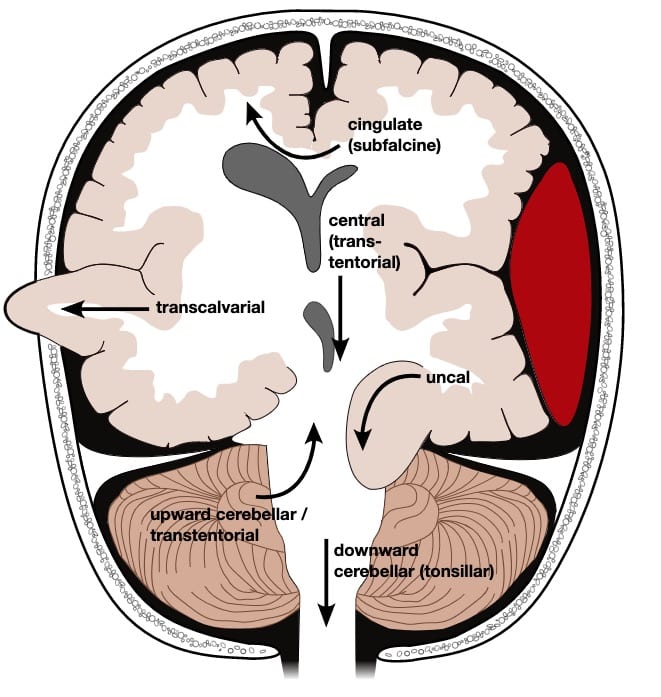
Brain Herniation Litfl Ccc Neurology
12 The syndrome is mostly seen in traumatic injuries and spinal cord neoplasms.

. There is no damage to the windshield but the bottom of the steering wheel ring is deformed. Emergency physicians are well versed in cerebral herniation pathology that typically results from increased intracranial pressure. We describe a case of paradoxical herniation following lumbar puncture in a patient with previous hemicraniectomy.
Surgery is advised when patients show no improvement within an appropriate time of conservative treatment. A Anterograde amnesia B Central neurologic hyperventilation C Retrograde amnesia D Cheyne - Stokes respirations 26 27 Your patient is a 7 - year - old male pedestrian who was struck by a vehicle. Central cord syndrome was described by Schneider in 1954.
Parkinsons disease or PD is a progressive illness of the nervous system. Which of the following may confound the assessment of the patient who has a mechanism of injury consistent with significant brain injury. Definition of Central Cord Syndrome.
Your patient is a 60-year-old female driver of a vehicle involved in a moderate-speed frontal collision. It is characterized by disproportionately more motor impairment of the upper than the lower extremities bladder dysfunction usually urinary retention and varying degrees of sensory loss below the level of the lesion. On your initial approach to the vehicle an EMT is in the back seat with manual cervical spine stabilization.
Transtentorial herniation TTH is a life-threatening neurologic condition that typically results from expansion of supratentorial mass lesions. Symptoms may include bradykinesia slow physical movement muscle rigidity and tremors. Central herniation is the subtype of downward transtentorial herniation of the brain that involves descent of the diencephalon and midbrain.
Behavior thinking sensation disorders and the sometimes co-morbid skin condition. Central cord syndrome is the most common form of spinal cord injury SCI in the United States with approximately 11000 cases occurring each year most from traumatic etiology. Central herniation syndrome typically results in which of the following.
However paradoxical herniation is less common and requires opposing treatments. Weakness in the abdominal wall caused by conditions that put strain on the wall. BSS caused by CDH is rare and often be delayed or incorrectly diagnosed.
1 Acute traumatic central cord syndrome ATCCS classically occurs in the setting of a hyperextension injury with preexisting cervical spine stenosis. In 1928 Stookey reported the first case of BSS produced by cervical disc herniation CDH. 26 Central herniation syndrome typically results in which of the following.
She was unrestrained but airbags deployed. It usually occurs with other types of downward herniation such as uncal herniation. A change in bedside pupillary examination is central to the clinical diagnosis of TTH.
Weakness at the incision site of a previous abdominal surgery which could result from an infection at the surgery site or failed surgical repairmesh placement. This type can occur when an infratentorial mass eg tumor in the posterior fossa cerebellar hemorrhage compresses the brain stem kinking it and causing patchy brain stem ischemia. In central or transtentorial herniation an expanding mass lesion of the midline frontal parietal or occipital lobe results in downward.
Central cord syndrome occurs when the damage is in the centre of the cervical spinal cord. Herniated disc material and nerve irritation may induce the production of inflammatory cytokines which can include. Displacement of the hemispheres basal ganglia and diencephalon through the tentorial notch.
This typically results in neck pain arm pain or weakness. Weakness in an area of the abdominal wall that was present at birth. Upward transtentorial herniation can occur when a significant increase in intracranial pressure in the posterior fossa causes displacement of the central lobule and superior surfaces of the.
A 15-year-old high school wrestler was found lying supine on the mat after sustaining a hyperextension injury to his neck while drilling during practice complaining of numbness tingling and a burning sensation in all 4 extremities. Which of the following may result from seizure worsening the condition of the patient with a traumatic brain. Although CR typically results from cervical disc herniation posterolateral is most common or cervical spondylosis several recent studies suggest myofascial pain may play a role in its clinical presentation.
Pressure and joint sensation may be preserved. This typically results in the loss of function in the arms but some leg movement may be preserved. Bender MD et al.
Compressive forces can result in varying degrees of microvascular damage which can range from mild compression producing obstruction of venous flow that causes congestion and edema to severe compression which can result in arterial ischemia. Some control over the bowel and bladder may also be preserved. A herniated cervical disc is an exceptional cause of BSS with rare cases.
Cervical disc herniation often results in neck and arm pain in patients as a result of direct impingement of nerve roots and associated inflammatory processes. Caused by the death of dopamine-producing brain cells that affect motor skills and speech. Both temporal lobes herniate through the tentorial notch because of bilateral mass effects or diffuse brain edema.
To alert athletic trainers to the importance of recognizing the signs and symptoms of central cord syndrome. Central pressure on the spinal cord may result in symptoms such as spasticity leg weakness or gait disturbances and even walking difficulty.
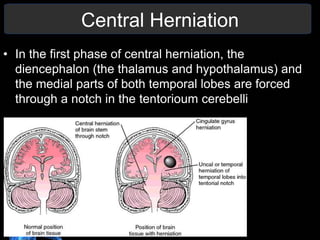
Herniation Syndromes

Uncal Herniation What Is It Causes And More Osmosis
Uncal Herniation Brain Herniation Syndrome Uncal Herniation Clinical Triad Of 1 Neurology Medical Knowledge Medicine Notes


Comments
Post a Comment